
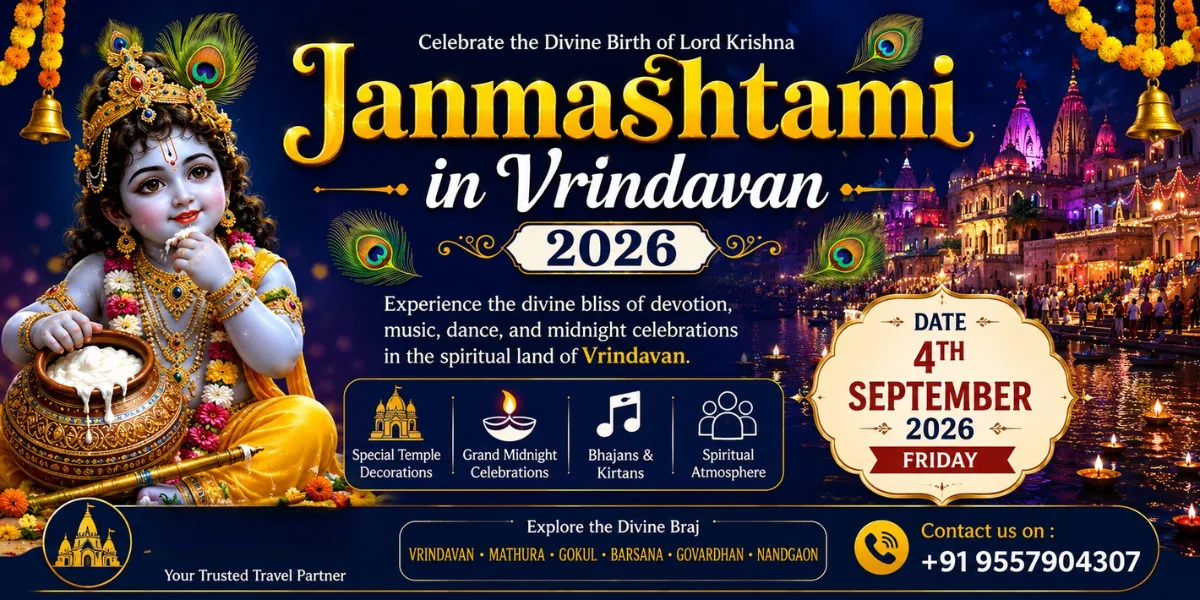
Janmashtami in Vrindavan 2026 falls on Friday, 4 September, with the midnight Nishita Kaal puja running from 11:56 PM to 12:41 AM and the divine birth moment marked at 12:18 AM on 5 September. ISKCON Vrindavan observes it a day later on Saturday, 5 September, and Dahi Handi follows on the same day. This marks the 5,253rd birth anniversary of Lord Krishna. Banke Bihari Temple holds its Mangala Aarti only once a year — on this night — making it the single most sought-after darshan in all of Braj.
There is no other night in Vrindavan quite like this one. I have spent Janmashtami here more times than I can count, and it never becomes ordinary — the lanes stay awake until dawn, temple bells fold into each other from every direction, and at the stroke of midnight a roar goes up across the whole town as Krishna is born again. If you are planning to be here on 4 September 2026, this guide covers the exact timings, which temples to prioritise, how the crowds actually move, and what to arrange before you arrive. With just weeks left, the practical parts matter as much as the devotional ones.
When Is Janmashtami in Vrindavan 2026?
Janmashtami 2026 falls on Friday, 4 September, observed on the Ashtami Tithi of Krishna Paksha in the month of Bhadrapada. The Ashtami Tithi begins on the evening of 3 September and continues through the night of 4 September, which is why the celebration peaks at midnight rather than during the day.
One point causes genuine confusion every year, so let me settle it plainly. The major Vrindavan and Mathura temples — Banke Bihari, Prem Mandir, Radha Raman, Krishna Janmabhoomi and Dwarkadhish — celebrate the main Janmotsav at midnight on 4 September. ISKCON Vrindavan, following the Vaishnava tradition, holds its primary celebration on Saturday, 5 September. Both are correct within their traditions, and many pilgrims simply stay for both.
Janmashtami 2026 Quick Reference Table
| Detail | Timing / Information |
|---|---|
| Janmashtami 2026 date | Friday, 4 September 2026 |
| ISKCON Vrindavan celebration | Saturday, 5 September 2026 |
| Nishita Kaal puja | 11:56 PM – 12:41 AM (46 minutes) |
| Midnight birth moment | 12:18 AM, 5 September |
| Dahi Handi | Saturday, 5 September 2026 |
| Parana (fast breaking) | After 6:00 AM on 5 September |
| Occasion | 5,253rd birth anniversary of Lord Krishna |
| Peak crowd window | 8:00 PM, 4 Sept – 3:00 AM, 5 Sept |
| Recommended arrival | 2 to 3 September |
In short: Janmashtami in Vrindavan 2026 is on Friday, 4 September, with midnight Nishita Kaal puja from 11:56 PM to 12:41 AM. ISKCON celebrates on 5 September, and Dahi Handi follows the same day.
Why Is Banke Bihari Temple Special on Janmashtami?
Because this is the one night of the entire year when Banke Bihari Ji gives Mangala Aarti darshan. Every other day of the year the temple opens later in the morning, and the pre-dawn Mangala Aarti simply does not happen here — a practice tied to the belief that Bihari Ji, worshipped in the mood of a beloved rather than a king, is not woken early. On Janmashtami alone that changes, and the aarti is held in the early hours after the midnight Janmotsav.
This single fact explains the extraordinary crowd. Devotees who have waited all year converge on the temple through the night, and the queue outside stretches deep into the surrounding lanes well before midnight. If Mangala Aarti darshan is your priority, you need to be in position hours early and you need to accept that the crowd will be intense. It is, by every account I have heard from pilgrims afterwards, worth it.
Key point: Banke Bihari Temple performs Mangala Aarti only on Janmashtami night, making it the most sought-after darshan of the year in Vrindavan. Reach the temple lanes several hours before midnight.
Which Temples Should You Visit for Janmashtami in Vrindavan?
Vrindavan has hundreds of temples, but on Janmashtami night a handful carry the celebration.
Banke Bihari Temple
The heart of Vrindavan’s Janmashtami. Midnight Janmotsav followed by the once-a-year Mangala Aarti. Expect the heaviest crowds in town.
Prem Mandir
The white marble temple is illuminated spectacularly for Janmashtami, with the evening light and fountain show followed by devotional programmes. Far more spacious than the old-town temples, which makes it comfortable for families and elderly pilgrims.
ISKCON Vrindavan
Celebrates on 5 September with continuous kirtan, the midnight abhishekam of the deities, and Chappan Bhog — the offering of 56 food items. Well organised, with clear queue management and international devotees in large numbers.
Radha Raman and Radha Damodar Temples
Smaller, older and quieter, these Goswami temples offer a more intimate Janmashtami with traditional abhishekam and bhajan. Good choices if the crush at Banke Bihari feels too much.
Shri Krishna Janmabhoomi, Mathura
Twelve kilometres away, this is the actual birthplace and holds the most emotionally charged midnight celebration anywhere. Many pilgrims do Mathura at midnight and Vrindavan at dawn, or the reverse.
| Temple | Main Celebration | Crowd Level | Best For |
|---|---|---|---|
| Banke Bihari | Midnight + Mangala Aarti | Extreme | The once-a-year aarti |
| Prem Mandir | Evening illumination, programmes | High | Families, comfort |
| ISKCON Vrindavan | 5 Sept, abhishekam, Chappan Bhog | High | Organised experience |
| Radha Raman | Traditional abhishekam | Moderate | Quieter darshan |
| Krishna Janmabhoomi, Mathura | Midnight Janmotsav | Extreme | The birthplace itself |
In short: Banke Bihari and Krishna Janmabhoomi carry the most intense midnight celebrations, Prem Mandir suits families, ISKCON is the most organised, and Radha Raman offers a calmer traditional experience.
What Happens During Janmashtami Night in Vrindavan?
The day builds slowly and then explodes. Through the afternoon, temples are decorated and devotees observing the fast gather for bhajan and kirtan. By evening the streets fill, Raslila performances begin at various venues, and the whole town takes on the feel of a festival that has been running for centuries — which it has.
From around 11:00 PM the intensity climbs sharply. Conch shells sound, kirtan grows louder, and at the Nishita Kaal, temples perform the abhishekam of the infant Krishna with milk, curd, honey, ghee and panchamrit. At the birth moment, the cradle is rocked, flowers are showered, and the sound that goes up across Vrindavan is something you feel rather than simply hear. Afterwards, prasad is distributed, Banke Bihari opens for Mangala Aarti, and the celebration carries on until sunrise. Dahi Handi follows on 5 September, with human pyramids forming to break the suspended pot of curd.
Key takeaway: The celebration peaks between 11:00 PM and 1:00 AM with abhishekam, the midnight Janmotsav and cradle rocking, then continues through the night with Mangala Aarti and prasad distribution.
How Crowded Is Vrindavan During Janmashtami 2026?
Very. This is the single busiest night in the Braj calendar, and lakhs of pilgrims arrive from across India and abroad. Roads into Vrindavan see diversions and vehicle restrictions from the afternoon of 4 September, the old-town lanes around Banke Bihari become entirely pedestrian, and hotels within walking distance of the temple sell out weeks ahead.
None of this should discourage you — it should simply shape how you plan. Arrive on 2 or 3 September rather than the day itself, so you are settled before the roads close. Stay within walking distance of the temples you care about most, because vehicles will not get you close. Keep your group small and agree a meeting point in advance, since mobile networks get congested and separated family members are the most common problem I see. Travel light, carry water, and leave valuables at your hotel.
Practical advice: Reach Vrindavan by 2 or 3 September, stay within walking distance of the main temples, and plan for road closures and network congestion on the night itself.
Where Should You Stay for Janmashtami in Vrindavan?
Location matters more than luxury on this particular night. A modest room ten minutes’ walk from Banke Bihari will serve you far better than a premium hotel on the outskirts that you cannot reach after the roads close. The areas around Banke Bihari, Loi Bazaar and the Prem Mandir stretch are the practical choices, along with the ISKCON guest house if you are attending the 5 September celebration.
With Janmashtami now weeks away, availability is already tightening sharply and rates have climbed well above normal. If you have not booked, do it immediately — every year I speak to pilgrims who left it late and ended up staying in Mathura or Chhata and commuting into a town they could not drive into.
Bottom line: Stay within walking distance of your priority temple. Availability is already scarce with the festival weeks away, so book without further delay.
How Should You Plan Your Janmashtami Trip to Vrindavan?
A two to three day plan works far better than arriving and leaving on the night itself. Reach on 2 or 3 September and use the calmer day to complete darshan at temples you would otherwise miss — Radha Raman, Radha Damodar, Seva Kunj, Nidhivan and the Yamuna ghats are all far more peaceful before the crowds arrive. Keep 4 September for rest during the day and the full night of celebration. Use 5 September for ISKCON, Dahi Handi and Mathura’s Krishna Janmabhoomi if you have not covered it.
If you would rather have the transport, stay and darshan sequencing handled, our Same Day Mathura Vrindavan Tour Package covers the essential temples efficiently, while the 2 Days Agra Mathura Vrindavan Tour suits travellers combining Braj with the Taj Mahal on the same trip.
Key takeaway: Arrive on 2 or 3 September, use the quieter day for the smaller temples, keep the night of 4 September free entirely, and extend to 5 September for ISKCON and Dahi Handi.
Plan Your Janmashtami 2026 Yatra With Us
Janmashtami in Vrindavan rewards those who plan and punishes those who improvise. Between road closures, sold-out hotels, temple queues that begin hours early and lanes that only locals navigate confidently, the difference between a chaotic night and a deeply moving one usually comes down to arrangements made in advance.
At Mathura Vrindavan City Tour, we handle accommodation close to the temples, comfortable transport, an experienced local guide who knows how the crowds move, and a darshan plan built around the actual timings rather than guesswork. With the festival now weeks away, the earlier you reach out, the better we can place you.
📞 Call or WhatsApp: +91 9557904307
🌐 Website: mathuravrindavancity.com
Final Word
Janmashtami in Vrindavan 2026 falls on Friday, 4 September, with the Nishita Kaal puja from 11:56 PM to 12:41 AM and the birth moment at 12:18 AM — the 5,253rd anniversary of Krishna’s descent. ISKCON follows on 5 September along with Dahi Handi. Reach Vrindavan by 2 or 3 September, stay within walking distance of the temples, and give yourself the whole night rather than a few rushed hours. Banke Bihari’s once-a-year Mangala Aarti alone justifies the journey. Get in touch with Mathura Vrindavan City Tour and let us arrange the practical side so you can give the night your full attention.
Faq’s for Janmashtami in Vrindavan 2026
1. When is Janmashtami celebrated in Vrindavan in 2026?
Janmashtami in Vrindavan will be celebrated on Friday, 4 September 2026. The festival marks the birth of Lord Krishna and is considered the biggest spiritual celebration in the Braj region. Many Vaishnava temples, including ISKCON, may observe the festival the following day according to their traditional calendar. Visitors can witness beautifully decorated temples, devotional singing, midnight celebrations, flower decorations, and grand darshan throughout the festival.
2. Why is Vrindavan the most famous place to celebrate Janmashtami?
Vrindavan is believed to be the place where Lord Krishna spent His childhood and performed many of His divine pastimes. Every street, temple, and ghat is associated with stories from Krishna’s life. During Janmashtami, the entire town becomes a center of devotion with bhajans, kirtans, Ras Leela performances, Jhankis, and elaborate temple decorations, making it one of the most authentic places in the world to experience Krishna’s birth festival.
3. Which temples should I visit during Janmashtami in Vrindavan?
The most important temples include Banke Bihari Temple, Prem Mandir, ISKCON Krishna Balaram Temple, Radha Raman Temple, Radha Vallabh Temple, Shahji Temple, Rangji Temple, Jaipur Temple, Gokulananda Temple, and Katyayani Temple. Every temple follows unique traditions, offering different types of darshan, devotional music, floral decorations, and special celebrations throughout the day and night.
4. What makes Banke Bihari Temple special during Janmashtami?
Banke Bihari Temple performs its famous Mangala Aarti only once every year on Janmashtami, making it one of the most awaited spiritual events in Vrindavan. Thousands of devotees gather before sunrise to witness this rare ceremony. The temple is decorated with thousands of flowers, beautiful lights, and traditional ornaments, creating an unforgettable spiritual atmosphere.
5. What happens during the midnight Janmashtami celebration?
The most important moment of Janmashtami occurs at midnight, symbolizing the birth of Lord Krishna. Temples perform Abhishek with milk, curd, honey, ghee, and holy water while priests chant Vedic mantras. Bells ring continuously, conch shells are blown, devotional songs fill the temple, and devotees joyfully welcome baby Krishna by offering Makhan Mishri, fruits, sweets, and prayers.
6. How crowded does Vrindavan become during Janmashtami?
Janmashtami attracts lakhs of devotees from India and around the world. Popular temples remain crowded throughout the day, while the evening and midnight celebrations experience the highest footfall. Roads near major temples may be restricted for vehicles, and security arrangements are significantly increased. Visitors should expect longer waiting times for darshan and plan their itinerary accordingly.
7. What is the best time to arrive in Vrindavan for Janmashtami?
It is recommended to arrive one or two days before Janmashtami. This allows enough time to check into your hotel, explore nearby temples before the peak crowds, and participate in the devotional programs leading up to the main celebration. Early arrival also helps avoid travel delays caused by festival traffic.
8. How many days should I stay in Vrindavan during Janmashtami?
A stay of three to four days is ideal. This gives you sufficient time to attend the Janmashtami celebrations, witness the midnight birth ceremony, participate in Nandotsav the following day, visit all the major temples, and explore nearby sacred destinations such as Mathura, Gokul, Govardhan, Barsana, and Nandgaon.
9. What is Nandotsav, and why should visitors attend it?
Nandotsav is celebrated on the day after Janmashtami and commemorates the joy of Nanda Maharaj after the birth of Lord Krishna. Temples celebrate with flower showers, sweets, devotional music, dancing, and colorful festivities. Many devotees consider attending both Janmashtami and Nandotsav essential for completing their Braj pilgrimage.
10. What kind of decorations can visitors expect during Janmashtami?
Temples across Vrindavan are decorated with thousands of fresh flowers, decorative lighting, colorful Jhankis depicting Krishna’s life, traditional artwork, peacock feathers, and beautifully adorned idols. Many temples create elaborate spiritual themes that attract photographers, pilgrims, and devotees from across the world.
11. Is Janmashtami in Vrindavan suitable for families with children?
Yes. Janmashtami is a wonderful spiritual experience for families. Children especially enjoy the colorful temple decorations, devotional processions, Jhankis, Krishna costume competitions, cultural performances, and stories about Lord Krishna’s childhood. Parents should keep children close because of the large crowds.
12. Is Vrindavan safe for solo travelers and international visitors during Janmashtami?
Yes. Vrindavan welcomes thousands of domestic and international visitors every year during Janmashtami. Police, volunteers, and temple management work together to ensure safety. Visitors should carry valid identification, stay hydrated, avoid carrying unnecessary valuables, and follow crowd management instructions.
13. What should I wear while visiting temples during Janmashtami?
Visitors should wear modest and comfortable clothing appropriate for religious places. Traditional Indian attire is preferred, but decent western clothing covering shoulders and knees is also acceptable. Comfortable footwear is recommended since visitors may need to walk considerable distances before reaching temple entrances.
14. Are hotels expensive during Janmashtami?
Due to extremely high demand, hotel prices generally increase during the Janmashtami festival. Premium hotels, guesthouses, and dharamshalas are often fully booked several weeks in advance. Booking accommodation early helps secure better rates and preferred locations near major temples.
15. Can I visit both Mathura and Vrindavan during Janmashtami?
Yes. Many pilgrims combine Mathura and Vrindavan because Mathura is the birthplace of Lord Krishna, while Vrindavan is where He spent His childhood and youth. A combined pilgrimage allows visitors to experience Krishna Janmabhoomi Temple, Dwarkadhish Temple, Vishram Ghat, Banke Bihari Temple, Prem Mandir, ISKCON Temple, and several other important spiritual sites.
16. What foods are commonly offered during Janmashtami?
Devotees offer Makhan Mishri, Panchamrit, Peda, Kheer, Dry Fruits, Fresh Fruits, Mishri, Panjiri, Butter, and various sattvic dishes prepared without onion or garlic. Many devotees observe a complete fast throughout the day and break it only after the midnight birth celebration of Lord Krishna.
17. Are photography and videography allowed inside the temples?
Photography is generally permitted in temple courtyards and public areas. However, many temples prohibit photography inside the sanctum or during special rituals. Visitors should always respect temple rules and avoid using flash photography during religious ceremonies.
18. What travel tips should first-time visitors follow during Janmashtami?
Book hotels and transportation well in advance, start temple visits early in the morning, carry drinking water, wear comfortable clothing, keep your mobile phone fully charged, carry valid identification, avoid carrying excessive cash, and allow extra travel time because roads near major temples may experience heavy congestion.
19. Why should I book a guided Janmashtami tour instead of travelling independently?
A professionally planned tour helps visitors save time, avoid traffic-related challenges, discover lesser-known temples, understand the spiritual significance of each place, and enjoy a hassle-free pilgrimage. Experienced local guides also help visitors attend important aartis and celebrations according to the festival schedule while making the most of their time in Braj.
20. How can Mathura Vrindavan City help me plan my Janmashtami pilgrimage?
Mathura Vrindavan City offers complete Janmashtami travel services, including customized tour packages, private AC cabs, hotel bookings, experienced local tour guides, Braj Darshan itineraries, temple sightseeing, group tours, family tours, and travel assistance throughout the festival. Whether you are visiting for one day or several days, the team helps create a comfortable, well-organized, and spiritually enriching pilgrimage experience.
📞 Call or WhatsApp: +91 9557904307
🌐 Website: mathuravrindavancity.com
