
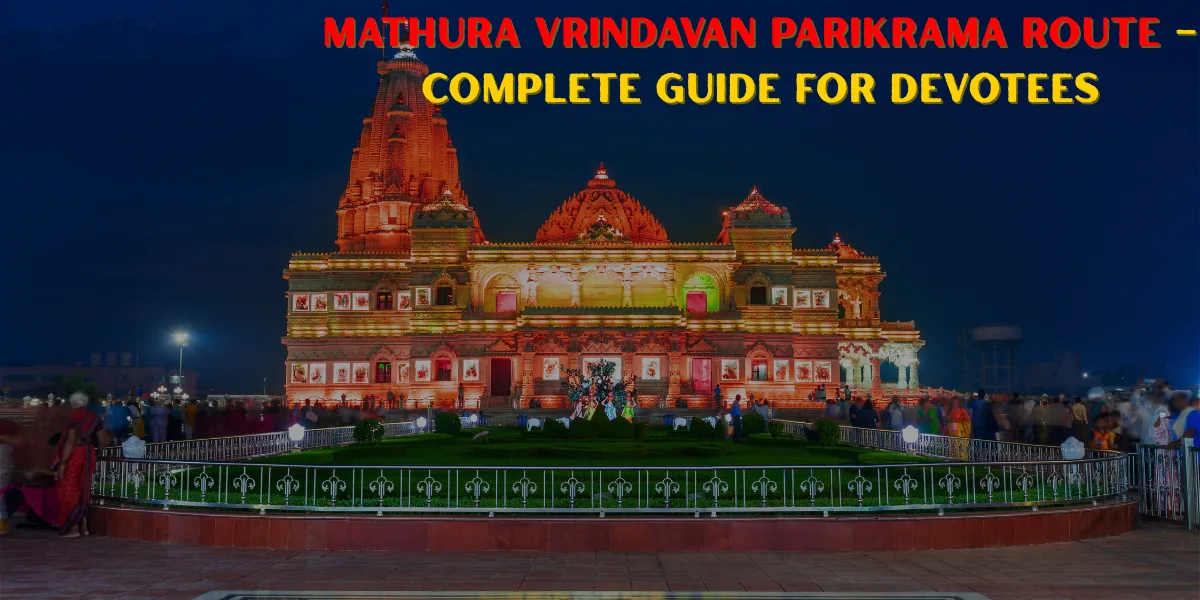
There are journeys that you begin with your feet, and there are journeys that begin inside you. The Mathura Vrindavan Parikrama Route is one such path. It is not a line on the map, but a circle of devotion which has no beginning and no end. The dust slowly rises, bells ring from distant temples, and the air smells of basil and old stories. Every step feels familiar, as if your soul has walked this road before.
Mathura Vrindavan Parikrama – The Walk That Speaks Without Words
Mathura Vrindavan Parikrama is not about going to a location, it is each presence in every step and at any time. The morning light slowly covers the ghats, the Yamuna flow like a mirror of gold, the air carries, “Radhe Radhe.” As pilgrims walk barefoot, some do so in silence, some softly singing Krishna’s name. The city gently wakes up, as if it remembers you.
The lanes of Vrindavan are narrow, yet they hold the width of centuries. At every turn, a small temple, a cow resting near the wall, a child offering flowers. You begin to realize that in Braj, faith does not speak—it breathes.
Parikrama Route Details – The Path That Knows Its Story
The Mathura Vrindavan Parikrama Route begins from Vishram Ghat, the quiet place where Krishna rested after ending Kansa’s pride. From there, the path moves through old lanes and temples whose walls have held prayers for generations. The Parikrama route details are not learned from signs; you simply follow the sound of bells, the sight of the crowd, and the pull of your own heart.
On the way, the smell of ghee lamps, the sight of garlands, the light music of the flute – everything becomes a companion. Even the dust on your feet seems sacred.
Vrindavan Parikrama Distance – A Walk That Measures the Heart
The Vrindavan Parikrama distance is said to be around ten to twelve kilometers, but here no one counts. Time bends quietly, and the journey moves at the pace of prayer. Temples like Madan Mohan, Govind Dev, and Radha Damodar come and go like verses in a song.
The peepal trees give shade, the Yamuna flows nearby, and sometimes the breeze carries the sound of temple bells from far away. You walk, and the world begins to slow down with you.
Mathura Parikrama Temples – Where Every Wall Knows His Name
The Mathura Parikrama temples are not built of stone alone. They are made of memory and music. The Dwarkadhish Temple, Keshav Dev, and Bhuteshwar Mahadev stand quietly, holding in their walls the names of all who have prayed here.
At every temple, lamps burn softly, conches blow, and the faces of devotees glow in their own light. The noise of the world fades. The heart begins to listen.
Govardhan Parikrama Guide – The Hill That Hears Every Prayer
The Govardhan Parikrama guide tells of a hill that is not a hill, but a god. It was here that Krishna lifted Govardhan on His little finger to protect the people of Braj. Today, thousands walk around it barefoot, their voices soft, their eyes filled with tears.
The walk is long — about twenty-one kilometers — but you never feel tired. You stop at Manasi Ganga, at Radha Kund, and Govinda Kund, bowing quietly. The stones feel alive. The hill seems to breathe. And you begin to understand that some places do not speak; they bless.
Braj Parikrama Yatra – The Land That Remembers Love
The Braj Parikrama Yatra is not just one route; it is the rhythm of an entire land. Mathura, Vrindavan, Barsana, Nandgaon, Govardhan, and Gokul — each is a page in the same story. People walk for days, barefoot and smiling, singing songs they may not have learned but somehow always knew.
The dust here clings to the feet like a blessing. The air tastes sweet. Even strangers greet each other with “Radhe Radhe,” and it feels like home.
Vrindavan Parikrama Timings – When the Heart Feels the Dawn
The Vrindavan Parikrama timings begin early, long before the sun. The world is quiet, the river soft, and the first sound you hear is of temple bells greeting the morning. Most devotees start walking around four or five, when the air is cool and the lamps are still burning in small corners of the ghats.
But time in Braj does not follow clocks. The right hour is whenever your heart opens. Some walk at dawn, some at dusk — faith keeps its own time.
A Spiritual Walk in Mathura – Between River and Memory
A spiritual walk in Mathura feels like walking inside a story that never ended. The ghats shine under morning light, the Yamuna carries lamps on its slow water, and the wind smells of sandalwood and smoke. The Mathura Vrindavan Parikrama Route ties all these threads together — the quiet of Vrindavan, the voice of Mathura, and the eternal rhythm of Braj.
Here, the sound of conches mixes with silence. The journey becomes less about the road and more about the peace that grows within.
Devotee Guide to Parikrama – Walk Softly, Walk with Love
The devotee guide to Parikrama is simple — walk slowly, walk humbly, and walk with your heart open. Carry little, speak less, and listen to the sound around you. Every step is prayer, every breath a chant.
On this path, no one walks alone. The people beside you, the cow crossing the road, the wind that touches your face — all seem to move with you, like companions from another life.
The Circle That Never Ends
The Mathura Vrindavan Parikrama Route is not a journey you finish; it is one that keeps returning. Whoever walks here once, walks again — not because they plan to, but because the land calls them back.
When the walk ends, when the lamps are gone and the chants have faded, a stillness remains. It is not emptiness, but peace — the kind that hums softly in the heart. That is Braj. That is the gift.
Brought to you by Mathura Vrindavan City — where the stories of Krishna are not written, they are lived.
Book Your Mathura Vrindavan Tour Package
Sometimes, the map lies within the heart.
And when the heart says, “Go to Vrindavan,” that whisper is not yours — it is His.
Let Mathura Vrindavan City take care of everything — the train, the flight, the car, the temple visits — so that you can take care of only one thing: your peace.
The road to Vrindavan is never difficult. Only the return feels heavy.
FAQs for Mathura Vrindavan Parikrama Route
1. What is the Mathura Vrindavan Parikrama Route?
The Mathura Vrindavan Parikrama Route is a sacred walk around the holy towns of Mathura and Vrindavan. It is not only a journey through temples and ghats but also a walk through devotion itself — where every step feels like prayer and every sound echoes Krishna’s name.
2. How long does it take to complete the Parikrama?
The walk usually takes about three to four hours, but no one here watches the clock. Some walk slowly, stopping at temples, resting under trees, or sitting quietly by the Yamuna. In Braj, time moves with faith, not with minutes.
3. What is the distance of Vrindavan Parikrama?
The Vrindavan Parikrama distance is nearly ten to twelve kilometers. Devotees walk it barefoot, starting before sunrise, while chanting and offering flowers along the way.
4. From where does the Parikrama in Mathura begin?
The Parikrama in Mathura begins from Vishram Ghat, the place where Lord Krishna rested after defeating Kansa. The name itself means ‘place of rest,’ and it marks the beginning of the divine circle.
5. What are the main temples on the Mathura Vrindavan Parikrama Route?
The Mathura Parikrama temples include Keshav Dev, Dwarkadhish, Bhuteshwar Mahadev, and many small shrines that line the narrow lanes. In Vrindavan, devotees visit Madan Mohan, Govind Dev, and Radha Damodar Temple. Each temple feels like a chapter from Krishna’s story.
6. What is special about the Govardhan Parikrama?
The Govardhan Parikrama is the longest and most sacred walk of Braj. Devotees walk around the hill that Krishna once lifted to protect His people. The air feels different there — calm, pure, and full of His presence. Every stone on Govardhan is believed to hold His touch.
7. What is the best time for Vrindavan Parikrama?
The Vrindavan Parikrama timings are early in the morning, around four to five a.m., when the air is cool and peaceful. The sunrise over the Yamuna feels like a blessing, and the sound of the conch fills the quiet lanes with devotion.
8. Can anyone do the Parikrama for the first time?
Yes, anyone with faith can do it. You don’t need experience or preparation. The devotee guide to Parikrama is simple — walk slowly, keep water with you, and let your heart lead you. Here, even the first step feels guided by something divine.
9. What should I carry during the Parikrama?
Carry light — just water, some offerings, and peace in your heart. Avoid shoes, walk barefoot, and keep your mind quiet. The less you carry, the more you feel.
10. Why is the Mathura Vrindavan Parikrama so special?
Because it is not a path you walk once; it is a circle that keeps calling you back. The Mathura Vrindavan Parikrama Route holds centuries of devotion, and whoever walks it once carries its peace forever. When the walk ends, the feeling does not. It stays — like a prayer that never stops.
